As an Amazon Associate I earn from qualifying purchases and sometimes recommend products from other sellers at no extra cost to you. For more details see my disclosure policy and privacy policy.
This post may contain affiliate links - I may make commission from any purchases.
So, you have a range of products, you know who your target market is and you have your pricing structure organised. You are ready to embark on the Etsy journey and start your first shop – it’s very exciting!
But before you launch there are some little tips to watch for and mistakes to avoid when starting an Etsy shop, here are some of the most common ones, all of which can have a negative effect on your shop and its potential traffic.
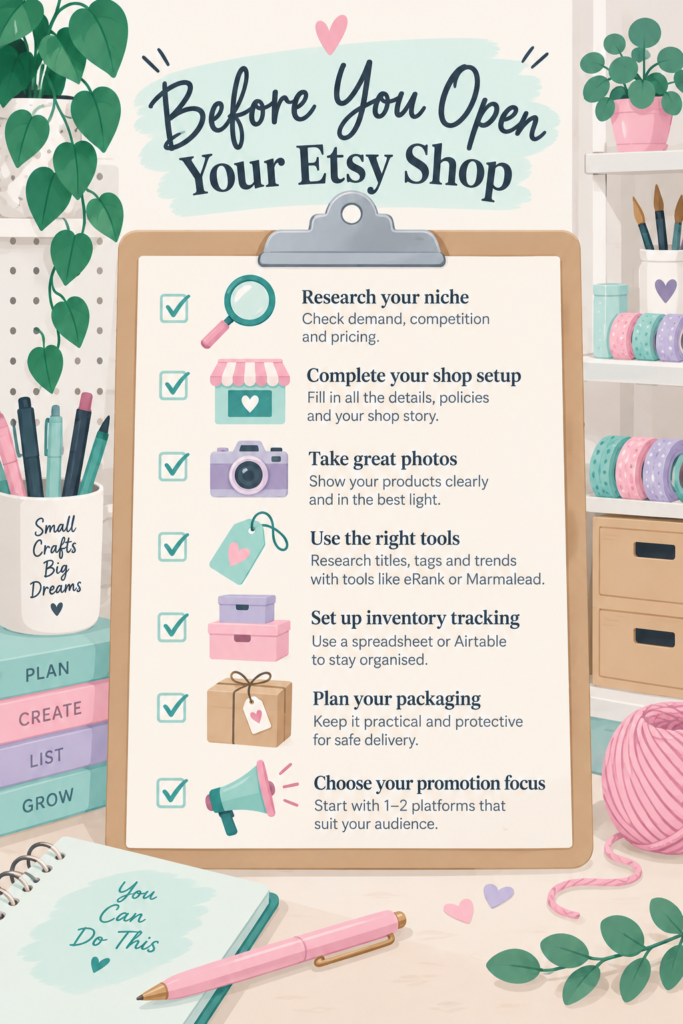
Table of Contents
Do your market research first
This is the mistake I see most often, and it’s one I’ve been guilty of myself. You fall in love with an idea, you make a batch of products, and only then do you find out nobody’s searching for what you’ve made, or the market’s already saturated with sellers doing it better and cheaper.
Before you list a single item, spend proper time researching whether there’s actual demand for it. Look at what’s already selling in your niche, how many listings you’re competing against, and what gaps exist that you could fill.
I’ve started using the Etsy app inside ChatGPT for this. You can tag @Etsy directly in a prompt and ask it about a product idea or niche, and it pulls back real listings you can compare for competition levels, pricing, and the angles other sellers are already taking. I’ve found it genuinely useful for spotting related keywords and gaps I wouldn’t have thought to search for myself, and it’s a much faster starting point than guessing.

It’s not a replacement for dedicated Etsy SEO tools like Marmalead or eRank once you’re ready to nail down your exact listing titles and tags, but as an early gut-check on “is this even worth making,” it’s saved me from a few dead-end ideas already.
Fill in every box
When you start with an Etsy shop, there is a whole load of boxes to complete. These include information about you, your shop policies, returns policies and more. Then there is the personalisation stuff such as adding an icon, a header image and giving your shop a story.
Don’t miss out any of these! It might seem that at first no-one wants to know why you make what or make and if you haven’t made a sale then a return policy isn’t crucial. But Etsy will spot these gaps and potentially not send you any traffic due to them.
Another advantage of filling in the About Me and other information is that you instantly start to build trust with your customers. You are a person (or a group of people) and you have a story that may not be exciting or thrilling but is real, so use this. Fill in all those About Me boxes and start connecting with people who come to your shop.
Get your photography right
I think that photography is an ongoing process and I’m still not totally happy with mine. But I’ve worked with a professional photography coach on my product photos and feel so much more confident with what I need to do. Now I just have to re-photograph them all.
You need to take eye-catching photos of your crafts and you need to know how to make the most of your photography for Etsy. If you want a fuller walkthrough of this, I’ve put together a separate guide on taking eye-catching photos of your crafts that’s worth reading before you shoot your first batch.
Use the right tools
You don’t need to do everything yourself as there are lots of great tools to help. When it comes to Etsy and how to list your items, I like Marmalead or eRank for SEO. Both are paid tools but is worth the investment in my opinion as you get vital information about what terms people use to search.
This helps you complete your title and tags, the two most important elements of SEO on Etsy. It is also great for inspiration and trending items if you are considering a new line, alongside the quick early checks you can do through ChatGPT’s Etsy app mentioned above.
Track your inventory
Whether you sell one of a kind items or multiples you should track your inventory from the start. There are lots of ways to do it from simple spreadsheets to proper software and what you need depends on your business and your budget. But adding this afterwards can be hard work so start it from the beginning.
My favourite way to track almost anything is Airtable. It is a combination of a database and a spreadsheet and there’s tons you can do with the free version. I also use it to track blog post information if you decide to do a bit of content marketing.
Don’t be afraid of discounts
When you first start a shop or things are slow, discounts might be the difference between making a sale and not. As long as the discount is well considered and affordable in your profit margins then it can be a great tactic.
I often do seasonal offers with Etsy for things like Black Friday or Christmas. I also offer discounts on my eBay shop where the more you buy, you increase your savings up to 25%.
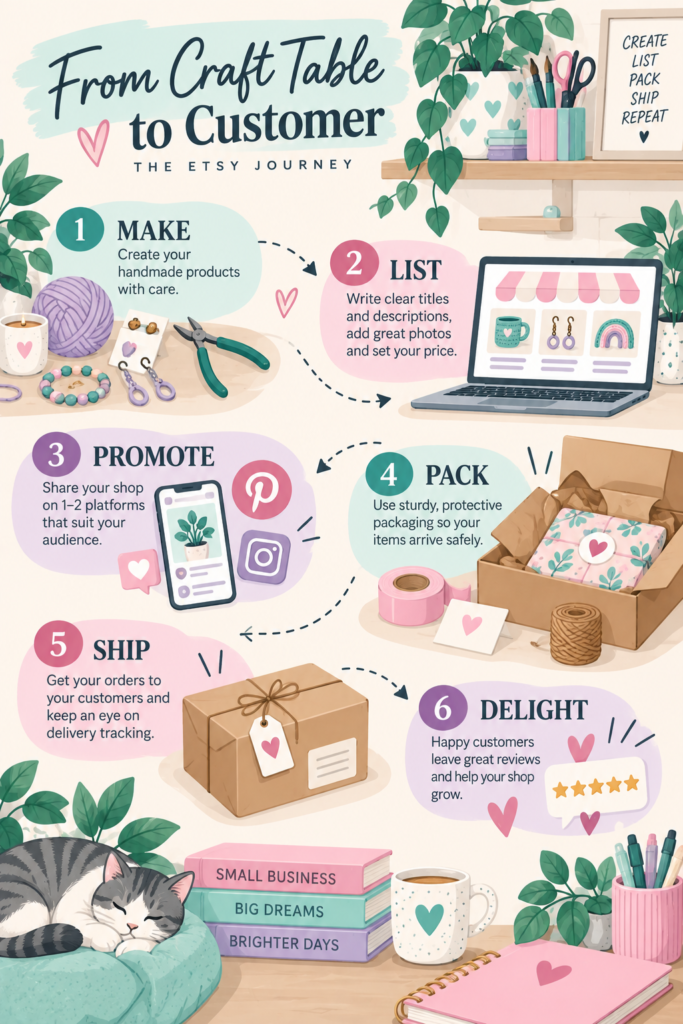
Get your packaging organised
Packaging is a crucial part of selling online. We’ve all had or heard complaints about items arriving broken, I’ve had them from Amazon even and other big shops. When the item is handmade, often one of a kind, then if it arrives broken it is even more devastating. So while pretty packaging is nice, practical packaging is much more important.
Study the ways your items could be damaged in the post and take steps to ensure your package can combat this. I even send cards in a bubble wrap envelope because some daft postman once folded a card in half to pop through a letter box because it was in a normal envelope. Not so easily done with a bubble wrap one.
If you’re short on space to store packaging materials alongside your stock, it’s worth reading through some of our craft room organisation content, since keeping packaging supplies tidy and accessible makes this whole job faster.
Don’t think of your Etsy shop as an island
I’m a freelance writer by trade so I’m a little biased towards the idea but stats do show that it is a benefit to your business to have a blog that works alongside your shop.
Now Etsy doesn’t host blogging so you will need to go somewhere else but there are lots of easy platforms to use, the top two are WordPress and Squarespace. We won’t talk about self-hosting domains and all that today but simply the idea of creating a blog, talking to your audience and sending traffic from the blog to the Etsy shop.
Eventually, as well as having a blog, you may decide to set up a proper website and sell some of your products through it. I’ve recently begun doing this myself, and if you’re a fellow crafter working out of a small space, you might find our small and shared spaces content useful for setting that side of things up without it taking over your home.
Get social
Today it is simply impossible to have an online shop and not do social media. Pinterest is a prime place for promoting your crafts while Facebook pages and groups have potential. Instagram is very visual so great once you get your photography organised.
Don’t try to overstretch yourself and be present on everywhere at once, start off with one or two and focus your attention on building a following. See what works and start to reach customers then expand your repertoire.
Don’t expect miracles
Sure, you hear stories about someone releasing a new product and a celebrity loving it and suddenly they are selling millions of items and are rich. They are great stories but they are one in a million or more.
Etsy is something of a mystery so don’t expect sudden miraculous results, if you go six months without a sale, then you will be joining any number of other people with the same experience. Stick to your plan, work on your shop and you will get there, as long as “there” isn’t a celebrity endorsement and instant millionaire status.
Frequently asked questions
How much does it cost to start an Etsy shop?
Listing a product on Etsy costs a small per-item fee, and Etsy also takes a transaction fee and a payment processing fee on each sale. Beyond that, your main costs are materials, packaging, and any tools or software you choose to use for SEO or design.
Do I need a business plan before I start selling on Etsy?
You don’t need a formal plan to list your first item, but having even a rough one, alongside some basic market research into whether people are actually searching for what you’re making, will save you time and money compared to listing blind and hoping.
How long does it take for an Etsy shop to start getting sales?
There’s no fixed timeline, and it genuinely varies a lot by niche and how much groundwork you’ve done on photography, SEO, and promotion before launch. Don’t be discouraged if the first few months are quiet, focus on the fundamentals covered above rather than chasing overnight results.
Conclusion
The good thing about these mistakes is that you can rectify all of them (though some will take more work than others!) but if you can remember these mistakes to avoid when starting an Etsy shop, then you will give yourself a smoother ride to profitability.