As an Amazon Associate I earn from qualifying purchases and sometimes recommend products from other sellers at no extra cost to you. For more details see my disclosure policy and privacy policy.
This post may contain affiliate links - I may make commission from any purchases.
The best e-commerce platform for selling crafts depends on how much control you want over your shop. Marketplaces such as Etsy, eBay, Folksy and Amazon Handmade are the quickest way to start, but they take a cut of every sale. Hosted builders such as Shopify and Squarespace give you your own branded shop for a monthly fee, and WooCommerce on a WordPress site is the best free option and gives you the most control.
As a crafter, you probably have more projects on the go than you could ever use yourself or give away. Supplies and equipment cost money, so selling some of what you make is the obvious way to pay for the habit.
Selling used to mean endless hours at a craft fair, hoping a few of the people through the door wanted what you had made. Now you can open an online shop in an afternoon.
What you do need is a platform to run it on. Facebook posts and direct messages stop being enough surprisingly quickly, and that is where an e-commerce platform comes in.
Table of Contents
What Is an E-Commerce Platform?
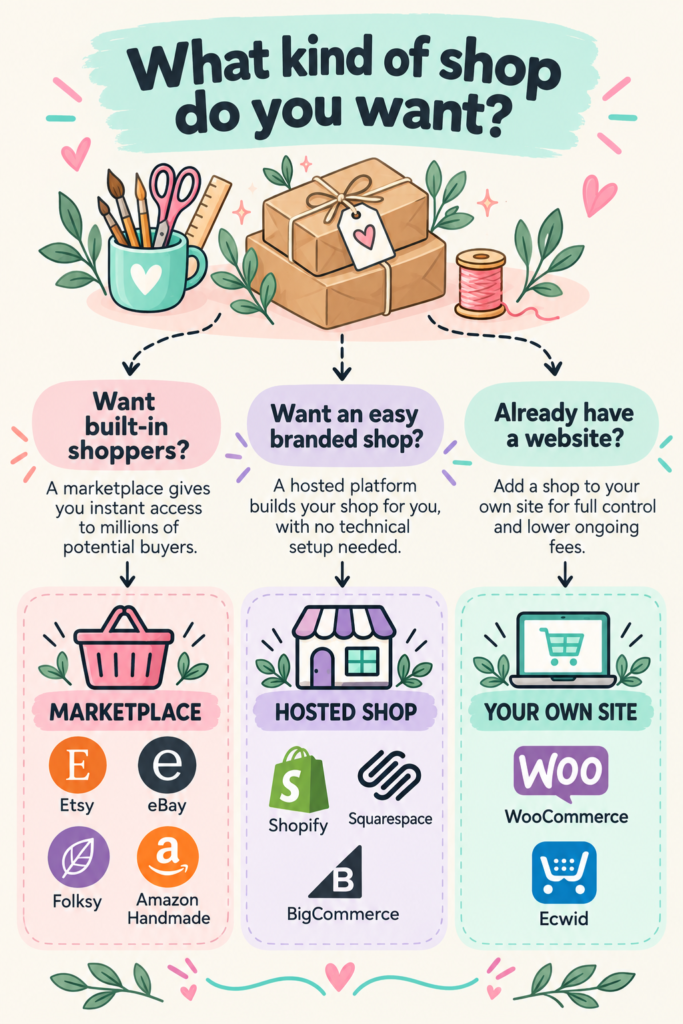
An e-commerce platform is the software that lets you list products, take payment and manage orders. There are three main ways to use one: a marketplace, a hosted platform or your own website.
Marketplaces such as Etsy are existing sites where you open a shop inside their platform. They are quick to start and bring some built-in traffic, but you have little control over how your shop looks and you pay fees on every sale.
Hosted platforms such as Shopify build the shop for you, either as a full website or as a shop you connect to a domain you already own. They remove most of the technical work, but they charge a monthly subscription and some add transaction fees on top.
Your own website is the third route. You buy a domain and hosting, then add shop software such as WooCommerce. It takes more setup, but it gives you the most control and the fewest ongoing fees.
Quick Comparison
| Platform | Type | How you pay | Best for |
|---|---|---|---|
| Etsy | Marketplace | Listing, transaction and payment fees | Testing demand for handmade items |
| eBay | Marketplace | Final value fee for business sellers | One-off pieces and cards |
| Folksy | UK marketplace | Listing fees or a Plus membership | UK-only handmade sellers |
| Amazon Handmade | Marketplace | 12.24% referral fee | Reaching Amazon’s audience |
| Shopify | Hosted | Monthly plan plus card processing | Your own branded shop |
| Squarespace | Hosted | Monthly plan | Design-led shops with a built-in website |
| BigCommerce | Hosted | Monthly plan, priced in US dollars | Selling across several channels |
| Ecwid | Hosted or plugin | Monthly plan, capped by product numbers | Adding a shop to a site you already have |
| WooCommerce | Own website | Free plugin plus hosting and card processing | Bloggers already on WordPress |
| Magento | Own website | Developer time and hosting | Larger businesses, not beginners |
What to Consider When Choosing a Platform
There is no right or wrong way to set up an online store. For my jewellery and cards business, Crystal and Yarn, I have tried three.
I used Shopify for a while and this is an option I’ve come back to for digital product businesses. I also had an Etsy shop selling selected jewellery and other physical crafts, and an eBay shop with a few individual jewellery pieces and all of my handmade cards.
I no longer sell on eBay because the sales dried up. I think that says more about people buying fewer cards than they used to than about eBay itself. The Etsy shop is now being converted into the shop for Crafting Her Plans, and Shopify has become the central store behind all of my products.
The lesson is that the right answer depends on what you sell and how many different things you sell. Nothing stops you changing platforms or adding another one later, and I have done both.
Fees also move around. Several of the platforms below changed their pricing during 2026, so check each platform’s own fees page before you commit.
Marketplaces
Marketplaces are big, established sites that let you open a shop inside their platform. You do not need a website, but you have much less control than you would with your own shop. On the plus side, they earn money when you sell, so they put effort into marketing and traffic.
Etsy
I have a love-hate relationship with Etsy. When I sold physical crafts there, I know I did not put as much work into the shop as some sellers do, but whatever I tried, I got a cluster of sales every three months or so. That is not much use if you want steady income.
Etsy is well known, trusted by buyers and built for handmade goods and craft supplies. It is easy to use and needs no website. The downsides are that its search ranking is hard to work out, you have limited control over how the shop looks, and the fees add up.
Etsy’s UK fees include a listing fee of 20 US cents (about 15p) per listing, a 6.5% transaction fee and a payment processing fee of 4% plus 20p. There is also a small regulatory operating fee, and VAT is added to Etsy’s fees for most UK sellers. If you are starting out, my guide to the 10 Mistakes to Avoid When Starting an Etsy Shop will save you some of the lessons I learned the slow way.
eBay
eBay has been around forever and is now a major e-commerce hub for all kinds of sellers. That is both a strength and a weakness. Buyers trust it and there is less handmade competition than on Etsy, but people do not always think of eBay when they want something handmade.
eBay also has its own search algorithm. When I was selling there, I found that listing or adjusting listings regularly gave me a decent shot at relevant traffic, and my cards sold well for years before the demand faded.
Private sellers in the UK pay no selling fees on eBay, but eBay expects anyone who makes items to sell regularly to use a business account. Business sellers pay a final value fee that varies by category, plus a per-order fee, a small regulatory fee and VAT on the fees.
Folksy
Folksy is a UK marketplace for handmade goods and craft supplies, and sellers need to be based in the UK. Because everything on it is handmade, you are not competing with imports or dropshippers.
The audience is much smaller than Etsy’s, so expect fewer visitors, but the buyers who do arrive are looking for UK makers. Folksy publishes its fees on its site, including a Plus membership with free listings, and it is worth comparing them with Etsy’s before you decide.
Amazon Handmade
Everyone knows Amazon, but fewer people realise it has a section just for handmade products. Unlike other marketplaces, you apply to join rather than simply adding a card and starting. Amazon reviews each application to check that your products are genuinely handmade.
Joining and listing are free, and Amazon deducts a 12.24% referral fee when you sell. You register on a Professional selling plan at £25 a month, but that fee is waived for approved Handmade sellers after the first month. Digital downloads and food are not accepted.
You can ship orders yourself or use Fulfilment by Amazon, which gives your listings a Prime badge. The trade-off is that Amazon is the brand buyers remember, so you build less recognition for your own business.
Hosted E-Commerce Platforms
Hosted platforms either give you a website or connect to one you already own, then build the shop on top. You get plenty of customisation, and the software looks after payments, tax and orders. The cost is a monthly fee, and some platforms add a percentage of each sale.
Shopify
Shopify is the platform I have the most experience with recently, and it has mostly been a positive one. There are plenty of themes to give the shop your own look, and a large library of apps to add features, some free and some paid. Unlimited products on every plan is a real advantage if your range grows.
In the UK, Shopify’s pricing starts with a Starter plan at about £5 a month, which does not include a traditional storefront. Basic is roughly £19 a month on annual billing or £25 month to month, and Shopify often runs a low-cost introductory offer for new stores. The downsides are that fees add up as you grow, and you still need to buy a domain if you want a non-Shopify web address.
Squarespace
I have less experience with Squarespace, but I know plenty of makers who love it. It is a cloud-hosted website builder, so you do not need separate hosting, and its templates make a stylish, mobile-friendly shop easy to put together.
Squarespace changed its plans in 2025 and 2026 to Basic, Core, Plus and Advanced. Core and above charge no Squarespace transaction fee on physical products, while Basic charges 2%, and digital products carry a fee on every plan. Prices have risen recently, so check the current UK pricing. Payment processing fees from Stripe, PayPal or Squarespace Payments apply on top.
BigCommerce
BigCommerce suits sellers who want to list across several places at once, such as Amazon, Facebook, eBay and Pinterest. It is not the easiest platform to learn, but it is good at tracking sales across channels.
BigCommerce restructured its plans and pricing on 1 June 2026, renaming them Core, Growth and Scale. It is no longer accurate to say it has no transaction fees, because a fee now applies if you use a payment provider it does not approve. Prices are in US dollars, and each plan has a sales cap that moves you up to a pricier plan as you grow, so it is a harder fit for a small UK maker.
Ecwid
Ecwid, now owned by Lightspeed, is a shop you add to a website you already have, including WordPress sites. It also works well with social media.
The forever-free plan has been withdrawn. Paid plans on its pricing page now start at about $5 a month and are capped by the number of products, with only 10 products on the entry plan. That makes it a reasonable fit for a small range and an awkward one for a growing shop.
Selling From Your Own Website
The third option is to buy a domain and sell from your own website. I have used this route on my blogs for small digital products that tie in with the theme of each blog.
WooCommerce and WordPress
If you want a free option, WooCommerce is the one I would choose. You need hosting and a domain with WordPress installed, then you add the free WooCommerce plugin to give the site shop features. WooCommerce itself costs nothing, though many extensions do, and you can build a perfectly good shop without paying for any of them.
I already have hosting with Lyrical Host for my other WordPress blogs, so the extra cost was close to zero. You do need to set it up yourself, and you need a payment processor such as PayPal or Stripe. The reward is a shop with no platform fees beyond what your payment processor charges, backed by WordPress, which I am a huge fan of.
I also use Shopify alongside my WordPress blogs. All of my products, digital ones included, sit in one central Shopify store, and each blog shows them through Shopify buy buttons on its own shop page. That means I manage stock, orders and payments in one place, and the blogs stay simple. If you only run one blog and want to keep costs down, WooCommerce is still the better fit. If you run several, one central store saves a lot of duplicated work.
Magento
You will see Magento mentioned a lot, so I have included it, but I do not think it is a sensible choice for a new maker. The software is free, but you need hosting, a website and enough coding knowledge to set it up. Its paid enterprise options are priced for much larger businesses.
A Note on Selz
Earlier versions of this guide covered Selz. Amazon bought the platform in 2021 and shut it down as a standalone service in 2022, so I have removed it.
Check the Tax and Fees Before You Open
Whichever platform you choose, selling regularly counts as trading in the eyes of HMRC. The trading allowance gives you up to £1,000 of tax-free trading income a year, but if your gross trading income goes above £1,000 you need to register for Self Assessment. This is general information rather than tax advice, so check your own position with HMRC or an accountant.
Fees come off your sales before you see them, and VAT is added on some of them. When you price an item, work out what Etsy, eBay, Amazon or your payment processor will take, so you know what is left for your materials and your time.
Finding the Right Platform
There is no single best option. You need to weigh up your own skills and time, how much you want to pay each month, and whether you want to deal with hosting at all.
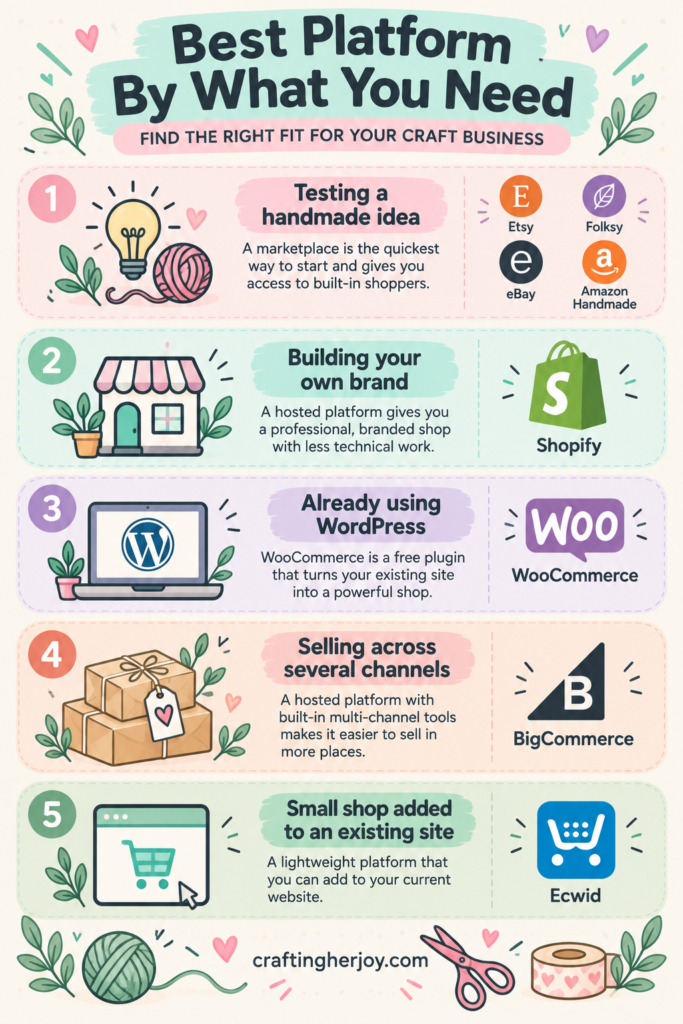
If you are testing demand, open a marketplace shop first. Etsy and Folksy are the natural starting points for UK handmade sellers, and eBay is worth a try for one-off pieces. If you already have an audience and want your own brand, use WooCommerce if you want a free option and are comfortable with WordPress, or Shopify if you want something quicker to set up and easier to grow.
Whichever you pick, a shop only works if people find it. Good pictures make a big difference, so read How to Take Eye Catching Photos of Your Crafts. Pinterest is also a strong source of traffic for handmade sellers, as I explain in Why Pinterest Is Worth It Even If You’re Not Selling Your Crafts.
Once the shop is live, it helps to know what buyers are looking for. How Colour Trends Affect Handmade Sellers (Without Losing Your Own Style) covers how to follow trends without losing what makes your work yours.
The best platform is the one you will actually use. Pick one, open the shop, and change course later if the numbers tell you to.